Have you ever hit a paywall while researching an important topic, or balked at the hundreds of dollars required for a single essential textbook? For millions of students, researchers, and casual readers worldwide, this isn’t just an inconvenience—it is a massive barrier to education and survival. Enter “shadow libraries,” the vast, often anonymous underground databases that bypass paywalls to offer free access to academic papers and books.
But if you think these platforms are simply a straightforward battleground between rogue digital pirates and massive publishing houses, you are missing the much bigger, wildly complicated picture. What was once a quiet rebellion has mutated into a global conflict involving multi-billion dollar tech companies, legal whack-a-mole, and deep ethical divides.
Here are three of the most surprising, counter-intuitive takeaways from the modern evolution of shadow libraries.
1. Shadow Libraries Are a Symptom, Not Just a Crime
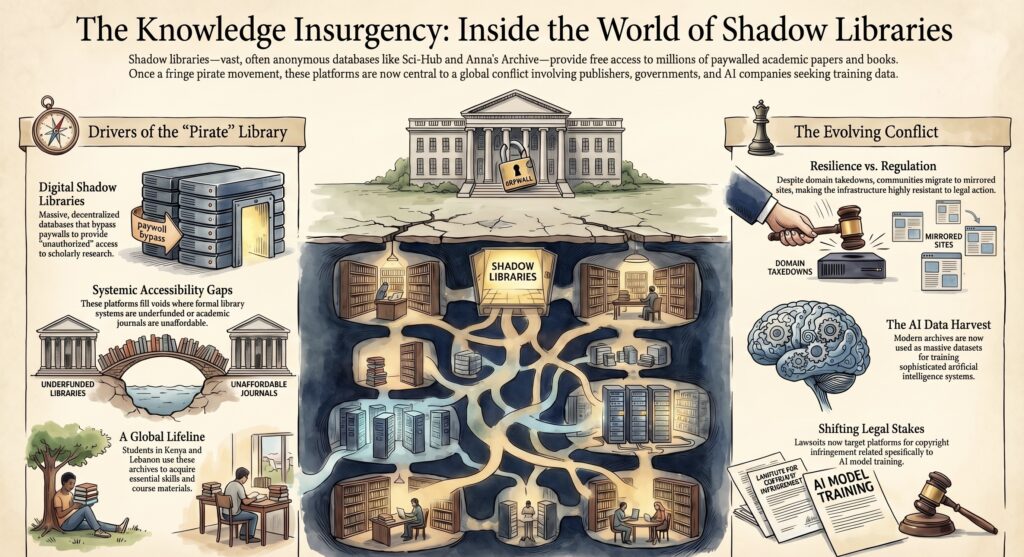
It is incredibly easy to look at platforms like Z-Library, Sci-Hub, or Anna’s Archive and dismiss them simply as hubs of illegal copyright infringement. However, a closer look reveals that their popularity is actually a direct reflection of systemic failures in our current educational and publishing systems. In countries where books are prohibitively expensive and public libraries are severely underfunded, these shadow platforms have stepped in to fill a massive void.
Users are not just looking for free entertainment; a mother in Kenya relied on Z-Library to learn new skills while raising her children, and students in Lebanon and India have depended on these platforms for essential course materials during times of severe economic instability. This forces us to reckon with an uncomfortable truth: while these sites operate in a legal grey area, they are providing a public good that legitimate systems are failing to deliver.
“The widespread use of shadow libraries reflects persistent access barriers, particularly in low- and middle-income contexts. While such platforms raise clear legal and ethical concerns and cannot be endorsed, focusing solely on enforcement without addressing the underlying access crisis would be insufficient.”
2. The New Biggest Beneficiaries of Piracy Might Be AI Tech Giants
Perhaps the most astonishing twist in the shadow library saga is their sudden value to Artificial Intelligence developers. These platforms are no longer just serving human readers; they are becoming massive, crucial data pipelines used to train sophisticated AI systems. In fact, a group of authors recently alleged in a lawsuit that Nvidia used shadow libraries, including Anna’s Archive, to obtain copyrighted works to train their AI models—a claim that Nvidia has denied.
This creates a fascinating and highly counter-intuitive ethical dilemma. Many supporters of the Open Access movement, who traditionally turned a blind eye to piracy when it helped marginalized students access knowledge, are deeply uneasy with this shift. There is a profound discomfort in watching large, incredibly wealthy technology companies potentially exploit these pirated datasets for massive financial gain. It completely flips the narrative from “Robin Hood stealing for the poor” to “Big Tech quietly profiting from the underground.”
3. There Is No Honor Among Digital Pirates
We often picture underground internet movements as unified fronts, banding together against a common corporate enemy. In reality, the shadow library ecosystem is deeply fractured and lacks any unified philosophy. These platforms are a loose network of projects with overlapping goals, but heavily conflicting values.
For instance, Anna’s Archive, which positions itself as a preservation-focused project, has openly criticized its peer Z-Library for restricting access to newly uploaded content, arguing that true openness requires easy sharing and mirroring. Meanwhile, Sci-Hub—one of the oldest and most famous academic shadow libraries—has actively distanced itself from these newer entrants. Further complicating matters, Anna’s Archive has faced intense criticism from within its own community for offering high-level data access to AI developers in exchange for massive donations, blurring the line between a free public resource and a commercial data broker.
The Future of Knowledge
The debate over shadow libraries is no longer a simple clash between readers who want free books and publishers who want to protect their revenue and intellectual property. Today, it is a multi-front war involving governments enforcing domain takedowns, activists pushing for completely legal public-sector “Diamond Open Access” repositories, and AI companies hunting for endless training data.
As legal battles intensify across multiple countries and AI continues to drastically reshape the value of online data, the future of these underground platforms remains highly uncertain. It leaves us with a critical, pressing question: In a world where knowledge is increasingly commodified for both human education and machine learning, how do we finally build a system that guarantees the fundamental right to read without relying on the shadows?